Technical buyer guide
How to Specify a Replacement Worm Shaft from a Sample
A sample-led replacement project succeeds when stable geometry is measured, wear is identified rather than copied, and the mating wheel or drive documentation is used to recover the intended mesh.
Why this question matters
For a buyer, replacement worm shaft from sample matters because it changes the information that belongs on the drawing, inspection plan or RFQ. The checks below turn the topic into purchasing decisions instead of leaving it as background theory.
Decision point
Choose trustworthy datums
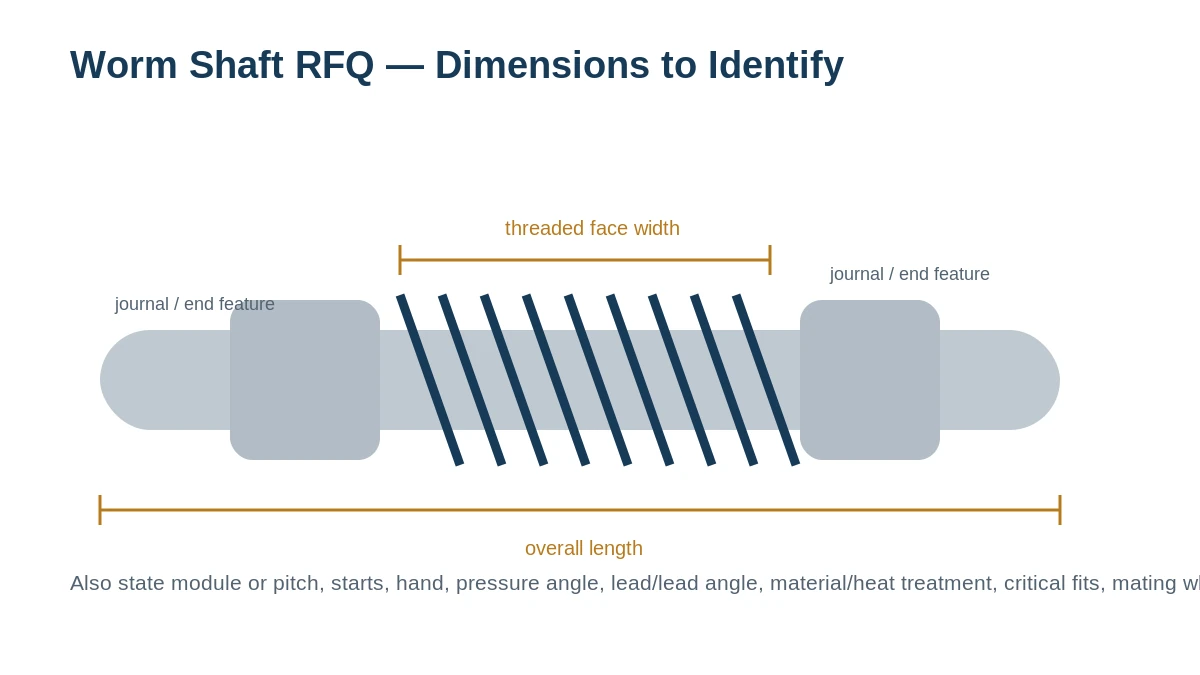
Bearing journals, shoulders and unworn end features can provide useful references. Worn tooth flanks and damaged keys need to be treated cautiously.
Decision point
Recover the mesh relationship
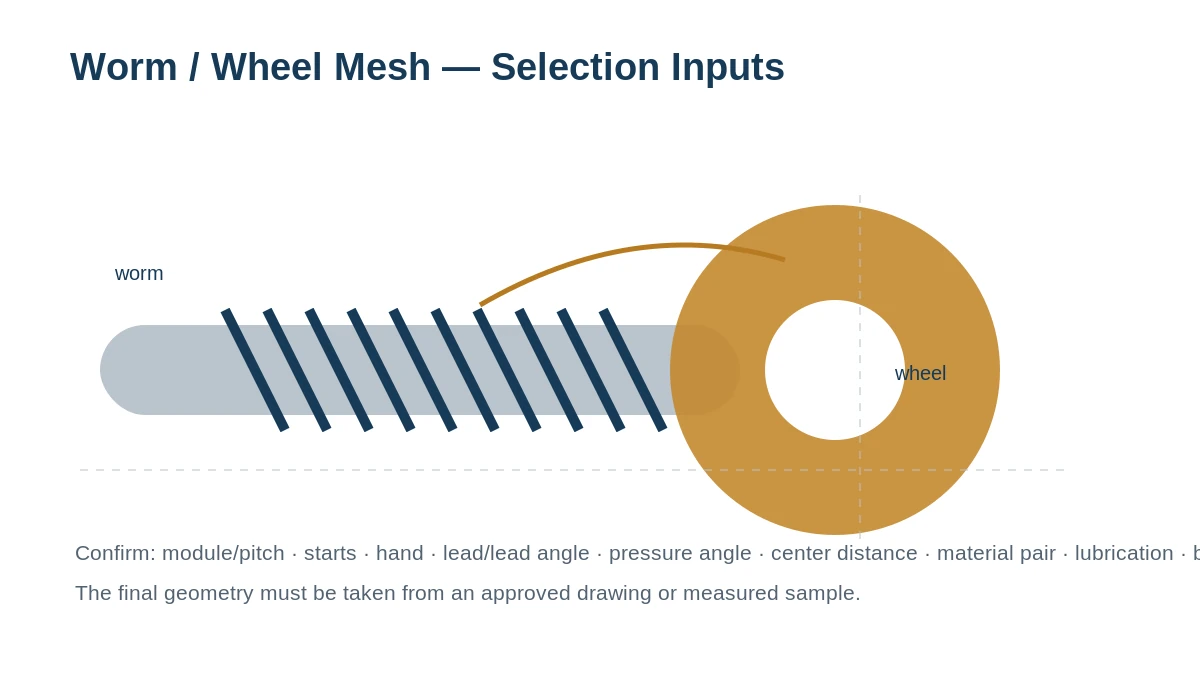
Use ratio, wheel tooth count, center distance, start count and any legible legacy documentation. If those are missing, send the wheel and assembly context together.
Approve a replacement drawing
Before production, convert the recovered information into an approved drawing or controlled specification so repeat orders are based on intent rather than another round of sample measurement.
RFQ fields to carry forward
| Parâmetro | Especificação/orientação |
|---|---|
| Part reference | Drawing/sample/model and revision. |
| Worm geometry | Module/pitch, starts, hand, lead/lead angle, pressure angle when known. |
| Roda de acoplamento | Tooth count/material/center distance or complete assembly reference. |
| Interfaces | Journals, shoulders and end features. |
| Duty | Speed, load, duty, lubrication, environment. |
| Order | Quantity, inspection/documents, target date and destination. |
Perguntas frequentes
Can I leave unknown values blank?
Yes. Mark them as unknown and attach the part/wheel or application context. A blank item is safer than a guessed technical value.
Does the website product table replace my drawing?
No. Product tables organize confirmed series context and RFQ requirements. The approved drawing or order specification controls custom geometry.
Can I order samples first?
For a replacement worm shaft from sample project, 1–5 samples can be considered where the manufacturing route is suitable. A very small 1–2 piece order is also possible, normally at a higher unit cost.
Practical check
Build the replacement drawing from trustworthy datums outward
Start from unworn bearing seats, shoulders, housing centers and mating-wheel evidence. Treat damaged tooth flanks, battered shaft ends or fretted journals as evidence of service condition, not as automatic nominal dimensions.
Use these four evidence classes while reconstructing the part: trusted datum, measured interface, derived mesh relationship and unresolved unknown. Keeping them separate reduces the chance of turning wear into a nominal dimension.
Working check
| Situation | What to verify |
|---|---|
| Trusted datum | Unworn locating face, center, bore, journal or housing reference. |
| Measured interface | Record value, measurement method and whether wear is visible. |
| Derived gear relationship | Keep ratio/center-distance/wheel evidence attached to the calculation or reconstruction record. |
| Unknown | Leave it open for review; an explicit unknown is safer than a silent assumption. |
Citação das interfaces reais
Solicitar um orçamento / Enviar solicitação de cotação
Envie o modelo ou a referência do desenho, a quantidade, a aplicação e a geometria que controla o ajuste e a malha. Valores desconhecidos podem ser identificados para confirmação, em vez de serem apenas estimados.