Application
Worm Shafts for Aerospace Actuation Projects
Actuation work is specification-led. The product name alone is not enough to infer qualification, traceability or inspection levels.

Buyer decision
What changes the worm shaft specification here
The useful starting point is the operating duty, not a generic industry label. For this application, put extra attention on drawing revision, material specification, special process requirements, inspection plan, lot traceability and application duty.
For aerospace actuation projects, review those inputs together with the mating worm wheel, center distance and shaft interfaces. The approved drawing remains the controlling reference for manufactured geometry.

Application RFQ checklist
| Input | What to provide |
|---|---|
| Drawing revision | State the actual value, condition or drawing reference for this project. |
| Material specification | State the actual value, condition or drawing reference for this project. |
| Special process requirements | State the actual value, condition or drawing reference for this project. |
| Inspection plan | State the actual value, condition or drawing reference for this project. |
| Lot traceability and application duty | State the actual value, condition or drawing reference for this project. |
Product paths commonly considered
Custom print-to-spec worm shaft; no aerospace qualification is implied unless separately documented. The final route depends on the complete mesh geometry, ordered material/treatment and inspection requirement.
For a aerospace actuation projects repair, include the old shaft and wheel together when the tooth data cannot be recovered reliably from the machine documentation.
How we move from application to part
Define the machine duty
Record the operating condition and failure/selection objective.
Identify the mesh
Confirm the mating wheel, ratio, center distance and known tooth data.
Lock shaft interfaces
Journals, shoulders, end features and mounting constraints come from the approved print or measured sample.
Choose a manufacturing route
Hobbing, grinding and treatment are selected for the actual specification, not as marketing defaults.
Quote and confirm
Quantity, documentation and delivery are agreed before production.
Domande frequenti
Can you select a worm shaft from the application name alone?
No. Application context helps us ask the right questions, but the worm/wheel geometry and shaft interfaces still need to be defined.
Should I send the mating worm wheel?
Yes when replacing an unknown shaft or when backlash/contact is a concern. A matched review is safer than assuming a standard mesh.
Can you make a small sample quantity?
For aerospace actuation projects, 1–5 samples can be considered where the manufacturing route is suitable. A 1–2 piece order is also possible, normally at a higher unit cost.
Application detail
Specification discipline matters more than an industry label
Aerospace-related enquiries can carry project-specific material, process, traceability and inspection controls. Those requirements must be supplied by the buyer and accepted for the actual order; this page does not imply an aviation approval, certification or qualified process that has not been documented separately.
The practical RFQ therefore starts with the controlled drawing and required records. If a process or inspection method is mandatory, name it explicitly instead of expecting it to be inferred from the application.
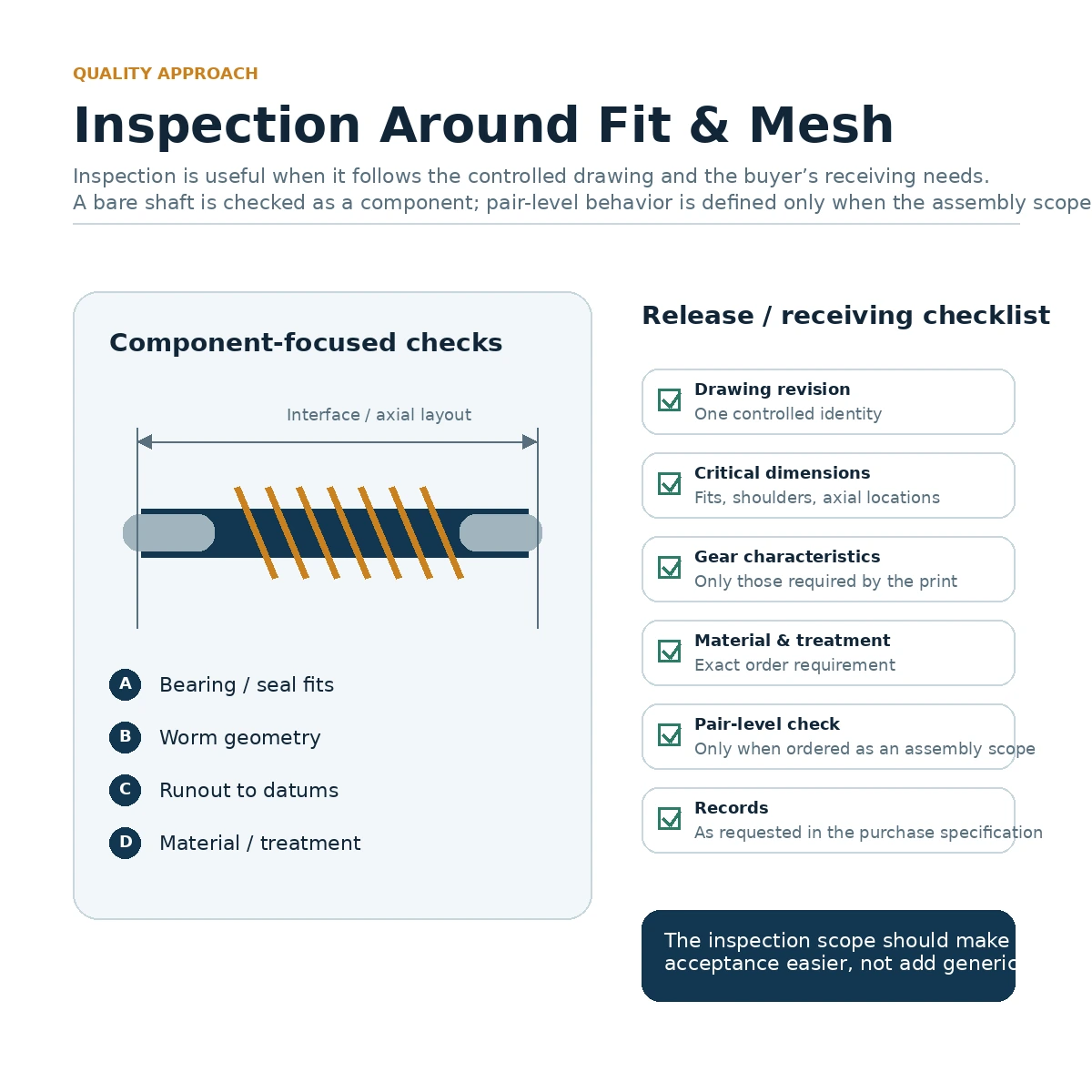
What to record before the RFQ leaves your plant
| Field | Why it matters |
|---|---|
| Controlled definition | Drawing/specification revision and exact part identity. |
| Material & process | Required grade and any customer-controlled treatment/process reference. |
| Traceability | Lot or document traceability requested by the purchase specification. |
| Inspection | Characteristics and records that require documented verification. |
| Change control | Any requirement for approval before material/process/manufacturing changes. |
Useful product routes from this application
Actuation projects with controlled drawings should start from the custom worm-shaft catalogue and the exact customer specification, not from a generic industry claim. The manufacturing route is chosen only after required material, process and inspection records are known.
Use the drawing RFQ checklist to keep revision, traceability and acceptance requirements visible. Any certification or approved-process requirement must be named by the buyer for the specific order.
Citazione dalle interfacce reali
Richiedi un preventivo / Invia una richiesta di offerta
Invia il modello o il riferimento del disegno, la quantità, l'applicazione e la geometria che controlla l'adattamento e la mesh. I valori sconosciuti possono essere identificati per la conferma anziché essere stimati.