Selection guide
Worm Shaft Selection Guide
A usable selection starts with the mating gear and machine duty, then works outward to the shaft interfaces. This guide helps organize the data before an RFQ.
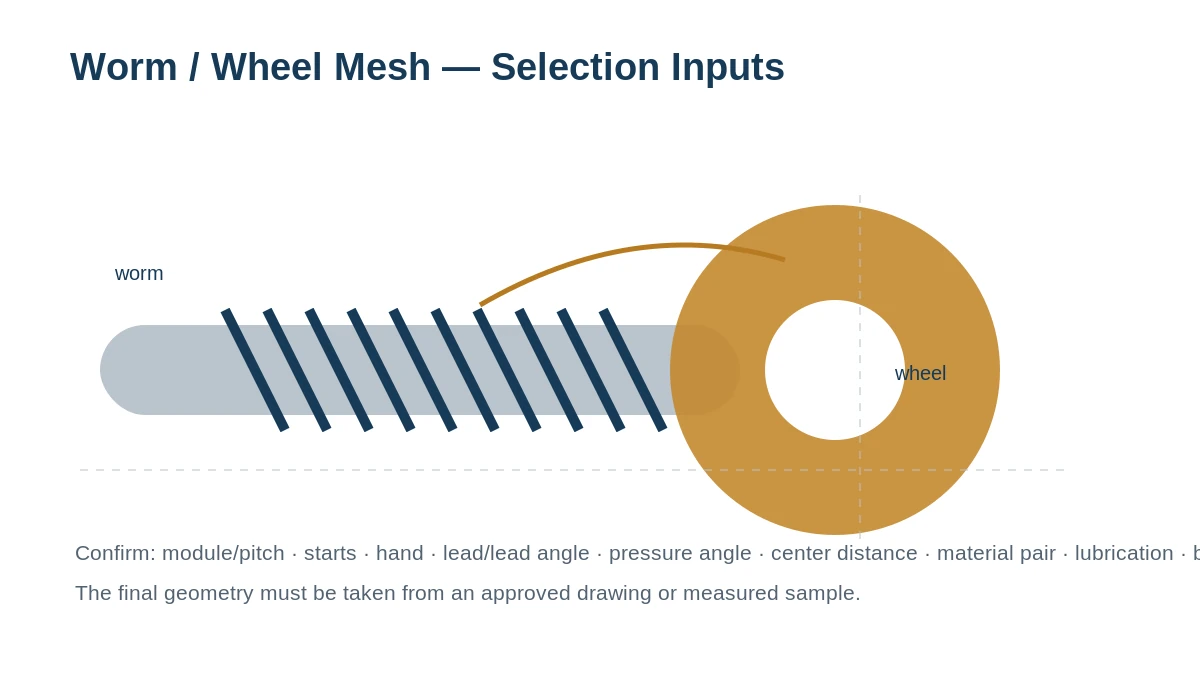
1. Identify whether you are designing, replacing or adjusting
A new design lets you select the worm and wheel together. A replacement usually starts from fixed center distance, wheel, bearings and end interfaces. A dual-lead adjustment problem starts with the existing assembly and the way axial worm movement changes the mesh. Those are different buyer tasks, so they need different data.
Core selection inputs
| Parameter | Specification / guidance |
|---|---|
| Worm / wheel relationship | Wheel tooth count, module or pitch, starts, ratio, hand, pressure angle, center distance and target contact/backlash behavior. |
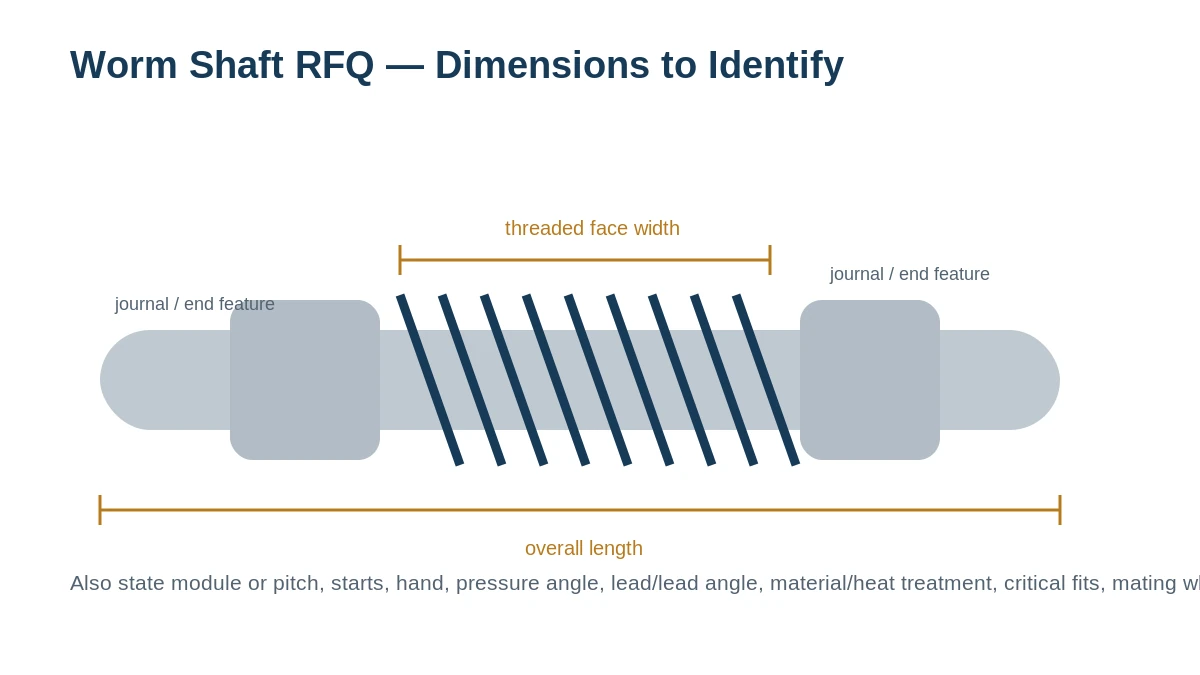
| Worm shaft geometry | Lead/lead angle, threaded face width, reference diameters and profile definition from the approved design. |
| Shaft interfaces | Overall length, bearing journals/fits, shoulders, keyways/splines, end threads, bores, couplings and seals. |
| Operating duty | Input speed, torque/load, duty cycle, direction reversals, shock, temperature, contamination and lubrication. |
| Material / treatment | Buyer-specified grade, heat treatment/hardness requirement, corrosion/wear condition and mating wheel material. |
| Production / inspection | Quantity, prototype or repeat program, critical characteristics, inspection documents, delivery and trade terms. |
Use one drawing to connect the tooth data to the shaft interfaces
If the thread geometry is shown on one document and the journals on another, include both references and revisions. A replacement quote can also start from a marked-up sketch or sample, but unknown dimensions should be called out rather than guessed.
2. Decide whether the start count is already fixed
The worm start count changes the relationship between worm rotation and wheel movement. In a replacement, it is normally fixed by the existing ratio and wheel. In a new design, it is selected with the wheel tooth count, lead angle, speed and efficiency target.
Do not choose “single start” simply because you want more torque, or “multi-start” simply because you want more speed. Those labels sit inside a complete mesh calculation and operating-duty decision.
3. Treat self-locking as conditional
Some worm drives resist back-driving, but the behavior depends on lead angle, friction, lubrication, temperature, load and the actual geometry. A safety-critical holding function needs a specific analysis and appropriate braking/holding strategy; a generic worm-shaft page cannot guarantee it.
4. Decide when to quote the pair
If the mating wheel is new, worn, undocumented or responsible for contact-pattern problems, quoting the worm and wheel as a set can remove uncertainty. Matched-set review is also useful when backlash or contact requirements are more important than interchangeability with an existing single part.
Frequently asked questions
What is the minimum information for a custom worm shaft?
A drawing or sample, quantity and the mating-wheel/drive reference. If a full drawing is not available, add module or pitch, starts, hand, lead or ratio, center distance and the critical shaft dimensions you can measure.
How do I select ground versus hobbed?
Base the choice on the drawing’s geometry, material/treatment sequence, required finished tooth quality and production economics. If the drawing does not specify the process, send the functional requirement instead of assuming the route.
Can I send a worn part?
Yes. Pair it with the worm wheel or drive information when possible, and identify surfaces that are worn so the intended geometry is not copied from damage.
Quote from the real interfaces
Request a Quote / Send RFQ
Send the model or drawing reference, quantity, application and the geometry that controls fit and mesh. Unknown values can be identified for confirmation rather than guessed.