Technical buyer guide
Worm Shaft Drawing Checklist for RFQ
A drawing can shorten quotation time only when it connects the worm geometry, shaft datums and end interfaces. This checklist shows what to mark before sending the RFQ.
Why this question matters
For a buyer, worm shaft drawing checklist matters because it changes the information that belongs on the drawing, inspection plan or RFQ. The checks below turn the topic into purchasing decisions instead of leaving it as background theory.
Decision point
Identity and revision
Put the part number, drawing revision, units, general tolerances and quantity on the document.
Decision point
Dane robaka
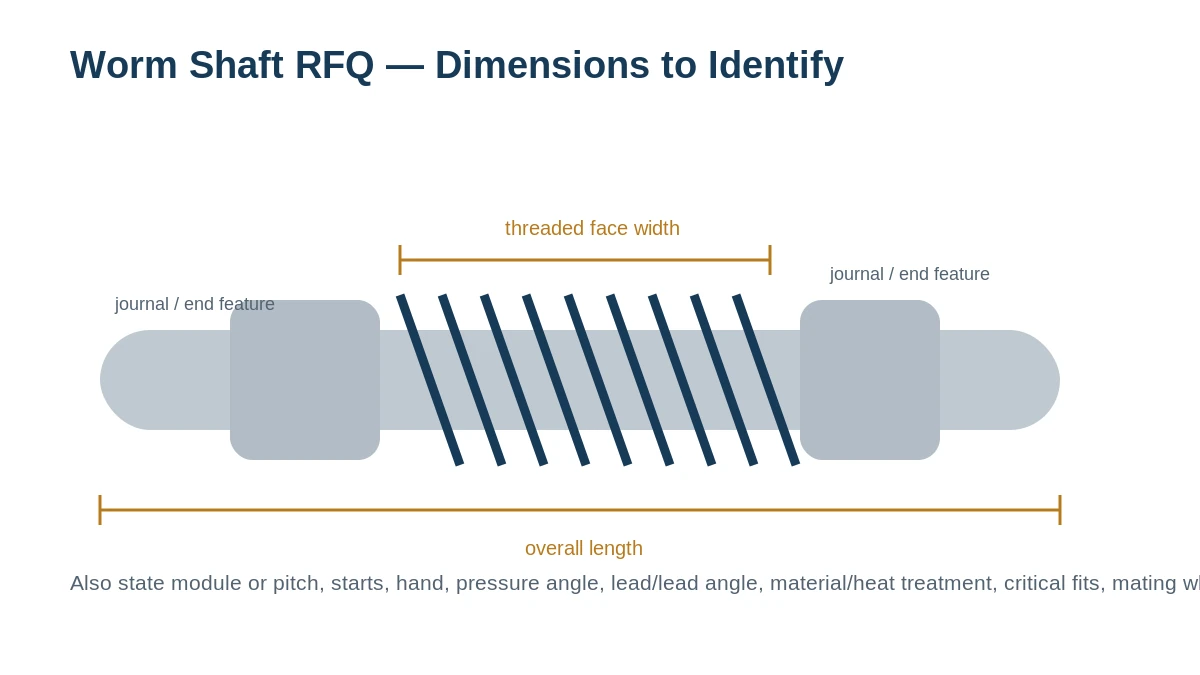
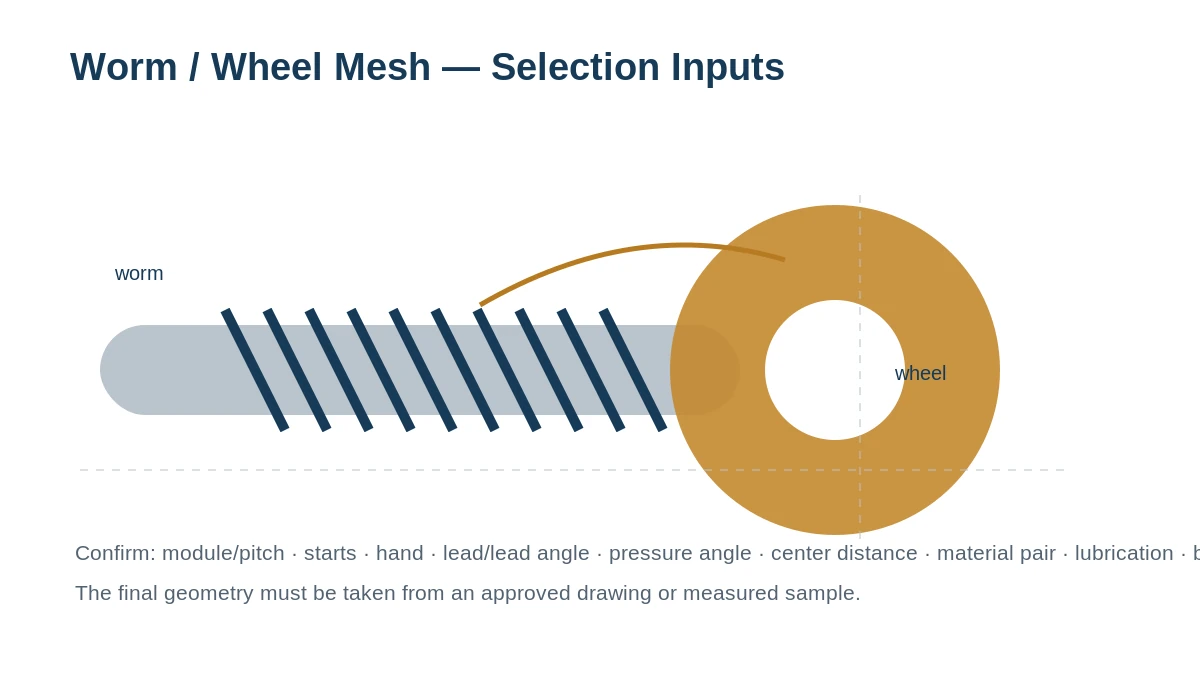
Add module or diametral pitch, pressure angle, starts, hand, lead/lead angle or the complete profile definition required by your design. Include the mating wheel or its tooth count/center distance where applicable.
Shaft data
Dimension the overall length, threaded face, journals and fits, shoulders, keyways, splines, end threads, holes and reference datums.
Material / process
State controlled material, heat treatment, hardness/depth, finish and inspection notes instead of relying on generic supplier defaults.
RFQ fields to carry forward
| Parametr | Specyfikacja / wskazówki |
|---|---|
| Part reference | Drawing/sample/model and revision. |
| Worm geometry | Module/pitch, starts, hand, lead/lead angle, pressure angle when known. |
| Mating wheel | Tooth count/material/center distance or complete assembly reference. |
| Interfejsy | Journals, shoulders and end features. |
| Obowiązek | Speed, load, duty, lubrication, environment. |
| Zamówienie | Quantity, inspection/documents, target date and destination. |
Często zadawane pytania
Can I leave unknown values blank?
Yes. Mark them as unknown and attach the part/wheel or application context. A blank item is safer than a guessed technical value.
Does the website product table replace my drawing?
No. Product tables organize confirmed series context and RFQ requirements. The approved drawing or order specification controls custom geometry.
Can I order samples first?
For a worm shaft drawing checklist project, 1–5 samples can be considered where the manufacturing route is suitable. A very small 1–2 piece order is also possible, normally at a higher unit cost.
Practical check
Put critical data where it cannot be separated from the part revision
A note in an email can be lost on a repeat order. Put stable worm geometry, shaft interfaces, material and critical inspection requirements on the controlled drawing or an explicitly referenced specification, then use the RFQ for quantity, timing and commercial details.
Treat the rows below as a document-location check: stable geometry belongs with the controlled part definition, while order-specific quantity and delivery information belongs in the RFQ. Keeping those roles clear makes repeat orders easier to control.
Working check
| Situation | What to verify |
|---|---|
| Drawing | Stable geometry, datums, interfaces, material/process references. |
| Referenced specification | Detailed treatment, inspection or customer requirements that are too large for the print. |
| Zapytanie ofertowe | Quantity, application, target date, destination and documents needed for this order. |
| Sample/photos | Evidence for replacement work when a complete drawing does not yet exist. |
Cytat z prawdziwych interfejsów
Poproś o wycenę / Wyślij zapytanie ofertowe
Prześlij numer referencyjny modelu lub rysunku, ilość, zastosowanie oraz geometrię kontrolującą dopasowanie i siatkę. Nieznane wartości można zidentyfikować w celu potwierdzenia, a nie zgadywania.