Replacement guide
Worm Shaft Replacement & Reverse-Identification Guide
A worn worm shaft can be reproduced only after the intended geometry is separated from wear, damage and assembly error. Send the mating wheel or drive reference whenever possible.
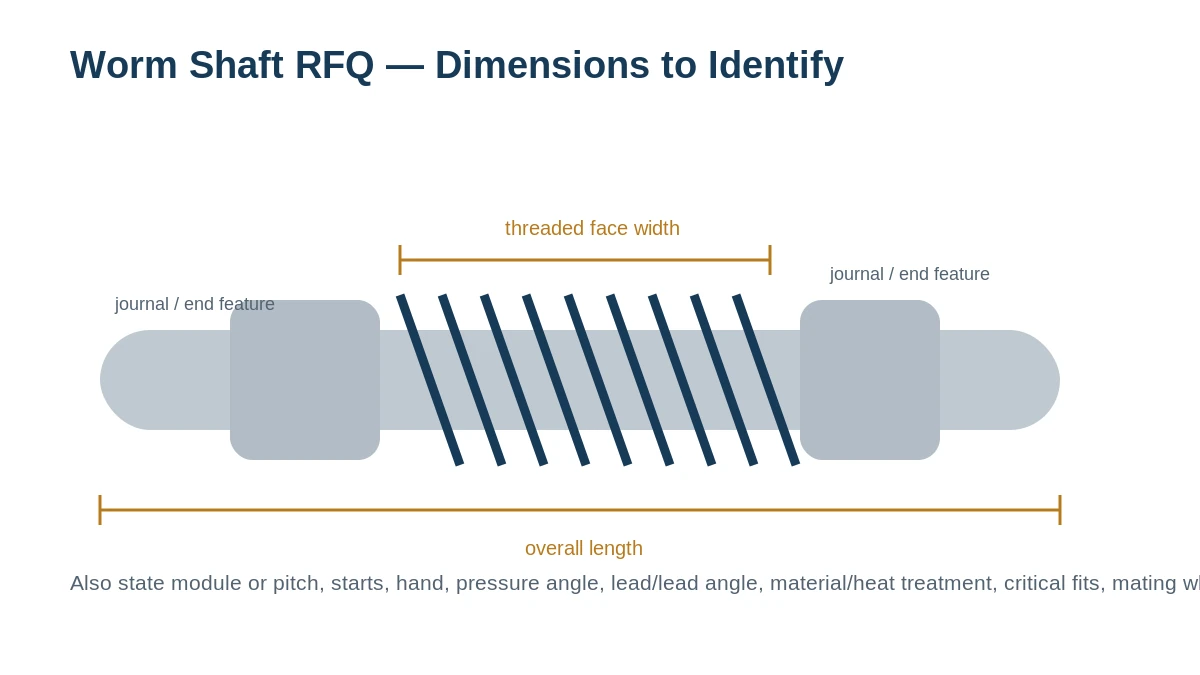
Do not copy wear into the new part
Polished flanks, pitting, local scoring or a damaged keyway can hide the original geometry. Measure stable datums and unworn interfaces first, then use the wheel, ratio, center distance and machine documentation to reconstruct the tooth relationship.
If the machine still runs, record direction, speed, ratio and any backlash/contact symptom before disassembly. That information often explains whether the problem is the shaft, the wheel, bearings, center distance or adjustment.
Replacement identification record
| Parameter | Specification / guidance |
|---|---|
| Machine / reducer | Manufacturer/model/reference if available; serial or internal drawing number. |
| Ratio / motion | Input-to-output ratio, rotation direction and known start count. |
| Mating wheel | Tooth count, material, bore/hub, condition and whether it will also be replaced. |
| Center distance | Existing housing or bearing-center dimension where it can be measured reliably. |
| Shaft geometry | Overall length, threaded face, journal diameters/lengths, shoulders, end features and any known fits. |
| Tooth data | Module/pitch, pressure angle, hand, starts, lead/lead angle or any legacy notation. |
| Failure evidence | Wear location, scoring, heat discoloration, pitting, looseness, bearing damage, lubrication condition. |
| Quantity / urgency | Prototype replacement, planned maintenance spares or repeat-production requirement. |
Mark what is measured and what is still unknown
A replacement sketch should distinguish measured dimensions from assumptions. Unknown tooth data can remain open for technical review; guessing a module or lead angle creates more risk than explicitly flagging the gap.
Citaat uit de echte interfaces
Offerte aanvragen / Offerteaanvraag versturen
Stuur het model of de tekeningreferentie, de hoeveelheid, de toepassing en de geometrie die de pasvorm en de maaswijdte bepaalt. Onbekende waarden kunnen worden geïdentificeerd ter bevestiging in plaats van te worden gegokt.